Showing posts with label marine life. Show all posts

Friday, January 5, 2018

Fresh start for 2018!


     Hello everyone, it has been a long 6 months away from the keyboard. A lot has happened within that time, I am heading for Florida in May to permanently live there. I got a new job (well old, new job) and will have more time to focus on myself and this blog now that I'm out of the old job. I'm super excited for what this year is going to bring!
   
     What you can expect from this blog within the next year...


  • Beach cleanup updates 
  • Green living DIY 
  • Their Story; will continue 
  • Marine life facts
  • SeaWorld updates
     I will also continue with recommendations on places to shop and people or businesses to support. I will be adding a segment monthly on the deaths of captive Orcas. This will be called "Lost Freedom" and I will be documenting whale deaths to show an impact on whales and their lives.  

     I am super excited to begin blogging again and seeing where my passion for the earth takes me and this blog next. Happy New Year everyone, here's to a GREEN new year!!   


Friday, April 21, 2017

Manatee Facts


     Manatees have been on the endangered species list for years but as of January 2016, the U.S Fish and Wildlife Service announced that the West Indian manatee has been removed from the endangered species list to the threatened species list. In the 1970s just a few hundred manatees were swimming the seas but the current population just in Florida is around 6,620. 
     
     There are 3 types of known manatee species:
  1. West Indian Manatee, the largest species of manatee in the world.
  2. Amazonian Manatee, generally found in freshwater lakes and lagoons.
  3. African Manatee, the least known species. 
Description:
    
      Manatees are close relatives to Elephants, Hyrax, Dugong and Stellar's Sea Cow. "Manatee" comes from the Crab word "manti" which means breast udder. Adults can grow to 13 feet long and weigh 1,300 pounds. Manatees are the largest herbivores in the ocean, they consume 10-15 percent of their body weight in vegetation every day. Manatees are large and gray with a paddle-shaped tail and they have two flippers with 3-4 nails on each. They also have a large snout with wrinkled faces and whiskers. Using their tails they can go short bursts at 15 mph but typically like to swim at a mere 5 mph. 

Habitat:

     Manatees can typically be found in shallow, slow-moving rivers, salt-water bays, canals, and coastal areas. Manatees are migratory and can be found in Florida in the winter. The summer months they can be seen from as far as Texas to Massachusetts. West Indian Manatees can also be found in coastal and inland waterways of Central America and along the northern coast of South America. Manatees can hold their breath for 15 to 20 minutes but they usually surface every 5 minutes to breathe. With one breath a manatee can replace 90 percent of the air in their lungs, compared to humans who can only replace 10 percent. 
     
Death and Protection laws:

      Manatees have no natural enemies and it is believed that they can live up to 60 years plus. Most manatee deaths are due to natural causes but a high amount of deaths is human-related. Most human-related fatalities involving manatees are usually collisions with watercraft or being crushed in canal docks. Another large percentage is the ingestion of fish hooks, litter, and entanglement in crab trap lines. The biggest and most serious threat to manatees is loss of habitat. Manatees are protected under the Manatee Sanctuary Act which states its unlawful to molest, harass, or disturb the animals. 

Offspring:

     Manatees are not sexually mature until 5 years old and their reproductive rate is fairly low. During mating, a female manatee will be followed by 12 or more males. One calf will be born every two to five years. A female manatees gestation period is about a year and mothers will nurse for the first two years of the calves life. 
     

Image result for manatee

Friday, February 17, 2017

Hundreds of whales die in mass stranding.

Image result for new zealand beached whales

     On February 9th, 2017, rescuers flocked to a New Zealand beach after hundreds of whales were found stranded. This mass stranding is thought to be the largest mass stranding in decades with 416 pilot whales beached. As the morning went on the DOC plead for locals to drop work and school to help the whales by bringing towels, buckets, and sheets to keep them cool and wet. High tide came at 10:30am and the remaining whales that were alive were relocated to their ocean home but early afternoon 90 of the whales ended up back on the shore. 
     It is very common for masses of whales to beach themselves as they are social beings and never leave their pods too far behind but most are now dead. New Zealand has had 3 mass strandings in its history. An astounding 1,866 have sadly died because of these mass strandings. NZ has one of the highest stranding totals in the world with around 300 whales and dolphins beaching themselves in a year, every year. There is no known cause as to why this issue is so overwhelming and prevalent in this area but it is thought to be most injured, sick or dying whales that end up on the beaches. 

Source:


Friday, January 6, 2017

Heart Broken.


     It is with a heavy heart I make this blog post today. This morning Seaworld announced Tilikum has passed away at the hands of captivity. My soul aches knowing he never got the freedom he deserved, taken from the ocean at only 2 years old he never saw his pod or the deep blue ever again. Tili was 36 years old, far too young to go, though SeaWorld claims it is "average," (The average life expectancy for a male Bull Orca is 70 years in the wild.) Tilly struggled with a bacterial infection for months on end, SeaWorld says it could happen in the wild or in "zoological settings." 
     
"While today is a difficult day for the SeaWorld family, its important to remember Tilikum lived a long and enriching life while at SeaWorld and inspired millions of people to care about this amazing species." - SeaWorld Cares

     Tilly was taken from his home in Iceland in 1983, he was transferred to Sealand of the Pacific in British Columbia. He took is first victim, a trainer by the name Keltie Byrne, pulling her in and drowning her. Soon after the incident, Sealand closed its doors and Tilly was sold to SeaWorld Orlando. He lived out the rest of his life in a 35-foot pool, he was 22 feet long. He performed for years until he took two more victims, a man who trespassed into the park and then in 2010 he took the life of his trainer Dawn Brancheau. After the death of his trainer, Tilly was sentenced to isolation and eventually in March 2011, returned to performing.
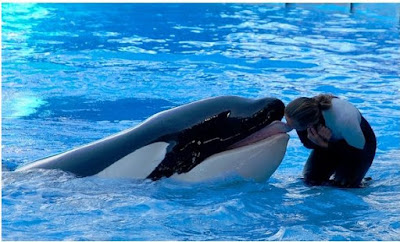

     On March 19, 2016, Seaworld released their first statement about Tilly's illness, and on June 29, they claimed he was making progress. If they had just let him go to a sanctuary he could have at least been in the ocean one last time, felt the freedom of being home once again. But now it's all over, his passing was unethical, indecent and inhumane, this could have likely been prevented had they shut down the breeding program sooner and got him "world-class" care at a sea sanctuary. 
     
     I am deeply saddened and affected by the passing of this beautiful and sensitive, caring creature. There has to be more we can do, we need to work even harder this year to prevent more casualties, fight harder for what we believe in and start a movement. We've gotten the breeding program shut down and the shows canceled but let's take a step further, let's get these whales to the ocean where they belong, we can't wait any longer. 

RIP TILIKUM. NOVEMBER 1981-JANUARY 6, 2017
NEVER FORGET.


Thursday, January 5, 2017

Whalecoming 2017!


      Happy 2017, we are whalecoming it with open arms are getting ready for bigger and better achievements and accomplishments to come in this new year. Here's your 2016 overwhalming recap, the achievements, and downfalls. 

  - January 
  • NOAA expands Critical Habitat for Endangered North Atlantic Right Whales
  • The DOC has started a 3-year research project on the Taranaki coast, studying Blue Whales
  • Taiji Dolphin hunt continues
  • Manatees are no longer endangered
  • Pollution could drive UK Orcas to extinction 
  • Victory for WDC in the battle against commercial whale hunting
  • Seaworld Orlando stops Beluga Whale interaction program 
  • Nearly 40,000 square miles of protection granted for 500 Right Whales
   - February
  • Seaworld admits their employees spied on PETA 
  • Seaworld reports they've lost $11 million in their quarterly earnings
  • A new film looks at the issue of whale and dolphin rights 
  • Toxic chemicals found in brains of beached whales
  • Beachgoers cause the death of a baby dolphin
    - March
    - April
  • Seaworld reveals Tilikums state of health 
  • Seaworld withdraws plans for expansions of Orca Tanks 
  • Green Sea Turtles no longer endangered in Florida
  • Gulf of Mexico perinatal deaths likely a result of oil exposure
    - May
  • Seaworld San Antonio announces new plans for dolphin habitat 
  • Seaworld reports more than an $84 million loss 
  • Whale Sanctuary Project to create seaside sanctuaries for whales and dolphins
    - June
  • Orca Awareness Month
  • WDC in the UK held "Walk for Whales"
  • Seaworld releases a new update on Tilikum's health
  • Sea Turtle recovering after being stepped on and beaten for selfies
  • Captive dolphin facility to close in Singapore
  • Pilot whale dies at Seaworld
  • US aquarium wants to create a sanctuary for captive dolphins
  • Georgia Aquarium will no longer take whales or dolphins from the wild 
    - July
    - August
  • Seaworld's stock hits an all-time low
  • Whale older than the Titanic seen off the coast of Washington
  • The FFWCC has reports Florida boaters are killing Manatees at a record-setting pace
    - September
  • California bans Killer Whale shows and breeding
  • Most Humpback Whales are no longer endangered
  • Seaworld cuts dividends  
    - October 
  • Adventure Aquarium to release Sea Turtle back into the wild
    - November 
    - December 
  • Captive dolphin park to be sued after dolphin death
  • Seaworld announces a plan to build a park in the Middle East 


Friday, October 14, 2016

SeaWorld: Their Reason For No Freedom


     On March 17, 2016, SeaWorld announced they were ending their captive breeding program and the orcas currently held in captivity would be the last. Later on, in the month SeaWorld announced that they would not be sending their orcas to Sea Sanctuaries.

"While most are celebrating these announcements, some critics want us to go further; they believe we should simply 'set free' the whales and release them into the ocean. We
believe that would likely be a death sentence for our whales."- SeaWorld Cares

     SeaWorld claims that "sea cages" are dangerous for the whales because they would be helpless to contagious diseases, that they'd be "sitting ducks" stuck in one place. A captive Orcas' current living conditions sound about the same, stuck in a tank with nowhere to go. These whales have more dangers living in the state they're in right now than they ever would in a sea sanctuary. 
     Orca whales need to swim and dive down far below the surface but in their tanks, there is nowhere to go, many suffer sunburn from the lack of depth in the tanks. Lack of space also causes a backlash, whales will get frustrated and become violent, when this happens there is nowhere to go. Many whales and dolphins as well have suffered from the skin being ripped off, being pushed out of their tanks and some have even died from the violence. This is what these whales endure every day and what they will continue to endure for the rest of their lives if they are not released. 
     In the article, SeaWorld Cares wrote they bring up Keiko. Keiko is a whale who was born into the wild and then captured and used for entertainment before being retired to a sea sanctuary. SeaWorld Cares, states that sea sanctuaries for whales are not a concept and there is not one sanctuary around the world. This is a false statement. They continue to say that Keiko was released into the wild and then died soon afterward. This is a false statement as well. Keiko lived years after being rehabilitated into the wild and reunited with his family; the point is that he died happily. 
     SeaWorld can make all these claims and a lot of people will believe them, but we can't, in order to make a difference you have to see right through them. There is multiple, factual evidence out there that this can happen. SeaWorld could make this happen if they wanted too, but they don't care, they care about one thing; the money.      

Read More About This Topic Here: 

https://seaworldcares.com/2016/03/Why-Sea-Cages-Are-Dangerous/
https://www.thedodo.com/seaworld-orcas-sea-sanctuaries-pens-1700373682.html


Friday, September 16, 2016

California Bans Captivity and Breeding!

     
     What we are doing is working, we are being heard. On September 13, California Governor Jerry Brown signed legislation that will outlaw Orca captivity and breeding programs like SeaWorld San Diego. Starting in June 2017, the Orcas that remain in captivity will only be used for "educational purposes." California is the first state to ban breeding and use of marine mammals in theatrical shows. 

Read More:


Friday, September 2, 2016

Their Story; Namu


     My name is Namu, I was the first healthy Orca to have ever been captured from the wild. I was the first healthy Orca to be displayed in an aquarium and perform with a human as well. I was captured in June 1965 and was sold to the Seattle Marine Aquarium for $8,000. The owner of the aquarium brought in a female whale named Shamu a few months after me, we didn't get along and she had to leave.
     I also starred in a movie called "Namu, The Killer Whale" or "Namu, My Best Friend" that was released in 1966. It was a fictional story set in the San Juan Islands. But after starring in a movie and performing for a year I passed away in captivity on July 9, 1966.


Rest In Peace Namu


Friday, August 26, 2016

Orcas Are Not The Only Animals Suffering.

picture from: www.sdnews.com

     We've done well. We've made some huge steps in the anti-captivity community, but are we doing enough? We spend so much of our time protesting for the Orcas, but what about the other animals who are still being bred? Forced to perform? Who are also stuck in the same small pools? Orcas are not the only animals suffering and we need to remember that. 


     SeaWorld's Bottlenose Dolphins are kept in a tank that is available to the public. Visitors can walk right up to the pool and pet the dolphins as they wish. SeaWorld doesn't ask visitors to wash their hands before touching, this has caused bacterial infections in the dolphins. 
     The Pacific White-Sided dolphins live in Beluga Stadium where they perform with Beluga Whales. The public can swim with the Beluga's, touch, hug and kiss them as much as they want. Many of the marine mammals living in SeaWorld already have low immunity to infection, adding public contact with an animal is dangerous and deadly. SeaWorld, as of February 2016 has reported 5 animals dead in an 8-month time span. 


SIGN A PETITION TO END CAPTIVE DOLPHIN BREEDING:


Friday, August 19, 2016

Why I Support SeaWorld Rescue.


     I know what you're thinking. "How do you support SeaWorld Rescue but not the parks?" Well, I'm going to tell you. There is a lot of facts and research that go behind my decision to support their rescue efforts. What you see in the parks, at the shows, those are mostly captive-bred animals who have never seen the ocean and have been forced to perform. But, a majority of the other animals who are living there are in rehabilitation and will soon be free to roam their homes again soon. 

     - Did you know that SeaWorld has rescued over 25,000+ animals? 


     - Did you know that SeaWorld is the largest rescue and rehabilitation program in the world?


     - Did you know only a small percentage of rescues do not get released? 

  
     - Did you know that, though SeaWorld's Orcas are not rescued, they have assisted in whale rescues?


More sources to check out below:      

Four reasons why condemning SeaWorld is a bad idea:http://awesomeocean.com/2014/12/04/four-reasons-condemning-seaworld-really-bad-idea/

SeaWorlds Rescue/Rehab information book: 

SeaWorlds conservation blog: 

The rescue of a Gray Whale Calf: 

Fact Check:

Friday, August 12, 2016

Their Story; Lolita.

Picture from www.grayline.com

     My name is Lolita, I'm 20 feet long and I weigh 7,000 pounds. I live in the Miami Seaquarium and I've been here since 1970. I was captured from my home on August 8, 1970, in Puget Sound, Washington. At first, they named me Tokitae, but renamed Lolita from some novel. I lived with a whale named Hugo for 10 years in an 80-35-20 foot pool in Miami, Florida. Hugo was captured two years before me but he passed away on March 4, 1980, and I've been in this pool all by myself since. 
     I have a lot of attention on me, I am known as the loneliest Orca in the world. I was part of a documentary called "Lolita; Slave To Entertainment." A lot of people fight for me and want me to be released back home, some have even started a protest at the Seaquarium where I live and started a hashtag online called "#FreeLolita." 
     I really like that people fight for my freedom, my tank is too small, to begin with. My tank violates Animal and Plant Health Inspection Services for size requirements. My tank should be at least 48 feet wide but mines only 35 feet wide; that only gives me 15 feet to swim. My tank is also very shallow and I get sunburns all over my body. 
     In November 2011, Animal Legal Defense Fund, PETA and a few others filed lawsuits against National Marine Fisheries Service to end the exclusion of me and my state of life from the Endangered Species Act. As of February 2015, I am now included in the endangered species list. My whole pod back home is also endangered.
     I am currently still living in the Miami Seaquarium all by myself. I still have to perform in shows and behave well. Please help me. 

Visit this website to learn more about me and how to help: http://hope4lolita.com/


Friday, August 5, 2016

SeaWorld: Announcing A Drop In Attendance

Picture from: www.theodysseyonline.com

    August 4, 2016, SeaWorld announced a major drop in attendance. The parks have lost over half a million visitors and have lost more than eighteen million dollars. This is the lowest drop since 2013 when "Blackfish" was released. For 3 years SeaWorld has been blaming poor weather and holidays for their decrease in visitors.
     In March 2016 SeaWorld announced the end to their captive breeding program in hopes to get an increase in revenue but it seems like it's not enough. SeaWorld has denied moving their whales to sea sanctuaries claiming it would be a "death sentence" for the whales. (Because keeping them in a tiny tank isn't a death sentence. *rolling eyes*)
     On Monday, August 1, SeaWorld announced Kasatka was being treated for a bacterial respiratory infection. Earlier in the year announcing Tilikum was dying of a mysterious respiratory infection. Both whales illness' were announced around the quarterly earnings report periods. SeaWorld is blaming both Tilly and Kat's infections on "old age."

Read more about this topic here: https://www.thedodo.com/seaworld-attendance-drop-1958918497.html

Friday, July 29, 2016

SeaWorld: End To Captive Breeding Program


     On March 17, 2016, SeaWorld announced that they will be phasing out Shamu Shows and ending their captive breeding program, this will be the last generation. These whales will live out the rest of their lives in their concrete habitats, with a new "natural encounter" show. 
    "SeaWorld has not collected an Orca from the wild in almost 40 years, and the vast majority of our orcas were born under human care. These orcas have never lived in the wild and could not survive in oceans that include environmental concerns such as pollution and other man-made threats."  - https://seaworldcares.com/en/Future/Last-Generation/

     Just a few short weeks after SeaWorld announced their end to the captive breeding program, CEO Joel Manby came out with a statement that shocked everyone. Basically. The decision to stop breeding wasn't for the welfare of the animals but because of money.
    "We understand some customers are upset and you may feel betrayed, but in a simple way, the data and trends showed it was either a SeaWorld without whales or a world without SeaWorld, we are an organization that needs to have cash flow to [succeed] and unfortunately, the trends were not in our favor."- https://www.thedodo.com/seaworld-breeding-ban-reason-1702760044.html
     
     If SeaWorld was interested in the welfare of their animals they would have allowed them to be sent to sea sanctuaries. SeaWorld has also claimed that putting captive-bred Orcas in the wild would be even worse than dropping them in the middle of the ocean. 


     SeaWorld doesn't care about their animals. 


Friday, July 22, 2016

Their Story; Shamu.

Picture from www.orcahome.de

      I am starting a series here called "Their Story;" I will be sharing with you the tragic story of every whale that has been captured and forced to perform for many places including SeaWorld. I wanted to start this series off with the original Shamu, she started a sickening trend in the entertainment industry and her story, as well as the others, needs to be shared. 

     My name is Shamu, nobody knows when I was born, only when I died. I was captured in Puget Sound, Washington in October of 1965. Very soon after I was captured I was sent to a Seattle Public Aquarium where I met Namu, Namu and I didn't get along very well so they sold me to SeaWorld San Diego in December 1965. I was forced to perform every day for 7 years before I got to retire. 
     I was retired for bad behavior. I bit on the legs and hips of one of the employees because I wasn't used to my trainer not wearing a wet suit. I attacked people in the past as well because they weren't wearing wet suits and that confused me. I showed a lot of erratic behavior during shows and they didn't know I was sick. Five months after I was retired as a performer I passed away in August 1971. 


Rest In Peace Shamu


Thursday, July 21, 2016

5 Facts You Want/Need To Know about the Orca;


     The Orcinus Orca whale is one of the most majestic creatures in all of the sea. Education about Orcas is my number one priority, I believe in the safety and conservation of these animals so here's a few facts that you want/need to know about these beautiful marine mammals. 

     1. Orca whales will live up to 50-80 years in the ocean, females lasting 20 years longer than males.
          - 1B. Orcas in captivity very rarely make it past 20 years old. 

     2. Orcas are known as the "Killer Whale" because they are at the very top of the food chain being an apex predator. 
          - 2B. Orcas are not hunted by any other mammal besides humans. 
               - 2C. Orcas are not truly killer, there has never been a record of an Orca killing a human in the wild. 

     3. Orcas use "echolocation" to prey on food and to navigate the large abyss. 
          - Echolocation: A psychological process for locating distant or invisible objects using sound waves reflected back to the emitter. - www.merriam-webster.com
     
     4. Orcas are part of the dolphin family. 
          - 4B. In rare instances, an Orca can mate with a Bottlenose Dolphin and give birth to a hybrid dolphin known as a Wholphin. 

     5. Orcas live in pods, each pod has its own unique sound and ways to communicate. 
          - 5B. Pods will sometimes work together forcing much fish into one area and take turns feeding. 
               -5C. Pods consist of 5-30 whales, some even combining to over 100. 
                    - 5D. Pods establish hierarchies and are always led by females. 


Wednesday, July 20, 2016

#OrcaWeek


     July 18-22 is Orca Week. This week is dedicated to all the whales being held in captivity at SeaWorld and other Seaquariums around the world. I thought this week would be the perfect time to launch this blog "over-whale-ming." This blog is dedicated to Tilikum, one of SeaWorld's captive whales. 
     I will cover topics ranging from SeaWorld to the documentary Blackfish and beyond. I am very passionate about marine life in general so occasionally you may find posts about other marine life or marine life-based subjects. I am so happy to be starting up this project, I hope I can make a difference in at least one whale's life. 
     The above picture is a formation of names I have compiled from lists of Orcas who are currently being held in or have deceased in captivity. Typing these names into the generator was overwhelming. Some of these whales haven't seen their pods in years, some have passed away in brutal ways and some have no clue that there is a whole other world waiting for them. These lovely creatures don't belong in a concrete bathtub. Please help them. 

Links that could help these whales get back home; at least into Sea Sanctuaries: